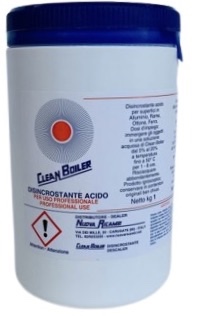
- Contains a synergistic blend of organic acids that give outstanding scale removal.
- CLEAN BOILER is used to remove inorganic deposits that develop on the surfaces
of food industry equipment such as packaging machines, pasteurizers, heat
exchangers, etc. - CLEAN BOILER is also frequently used in the maintenance and cleaning of parts
and components of coffee machines, dishwashers, etc. - CLEAN BOILER is a crystalline, odorless, and colorless hygroscopic powder. In a
1% solution, it has a pH of 1.18. - CLEAN BOILER is particularly suitable for treating surfaces such as aluminum,
copper, brass, and iron because, while it provides effective descaling, it is NOT as
aggressive as other strong acids. - CLEAN BOILER is also appreciated for other qualities such as easy handling, no
fumes, and no toxicity.
Acid descaler for aluminium, copper, brass, iron surfaces
USAGE INSTRUCTIONS
AND DOSAGES
CLEAN BOILER can be used in flow or immersion at a concentration of 5% to 20%
(depending on the degree of encrustation), at a maximum temperature of 50–60°C
and for a maximum period of 8 hours. Always rinse plenty after use.
Caution: CLEAN BOILER is a hygroscopic product; store in the original, tightly
closed container.
OTHER
INFORMATION
CLEAN BOILER is classified and labeled as an IRRITANT SOLUTION (Regulation
1272/08, Regulation 1907/06). Always check the safety data sheet for handling and
operating instructions.
Hazards identification
2.1. Classification of the substance or mixture
The product is classified as hazardous pursuant to the provisions set forth in (EC) Regulation 1272/2008 (CLP) (and subsequent amendments and
supplements). The product thus requires a safety datasheet that complies with the provisions of (EU) Regulation 2020/878.
Any additional information concerning the risks for health and/or the environment are given in sections 11 and 12 of this sheet.
Hazard classification and indication:
Eye irritation, category 2 H319 Causes serious eye irritation.
Skin irritation, category 2 H315 Causes skin irritation.
Hazardous to the aquatic environment, chronic toxicity,
category 3
H412 Harmful to aquatic life with long lasting effects.
Label elements
Hazard labelling pursuant to EC Regulation 1272/2008 (CLP) and subsequent amendments and supplements.
Hazard pictograms:
Signal words: Warning.
Hazard statements:
H319 Causes serious eye irritation.
H315 Causes skin irritation.
H412 Harmful to aquatic life with long lasting effects.
Precautionary statements:
P280 Wear protective gloves / eye protection / face protection.
P337+P313 If eye irritation persists: Get medical advice / attention.
P264 Wash . . . thoroughly after handling.
P273 Avoid release to the environment.
Other hazards
On the basis of available data, the product does not contain any PBT or vPvB in percentage ≥ than 0,1%.
The product does not contain substances with endocrine disrupting properties in concentration ≥ 0.1%.
Composition/information on ingredients
3.2. Mixtures
Contains:
Identification x = Conc. % Classification (EC) 1272/2008 (CLP)
SULPHAMIC ACID
INDEX – 60 ≤ x < 80 Eye Irrit. 2 H319, Skin Irrit. 2 H315, Aquatic Chronic 3 H412
EC 226-218-8
CAS 5329-14-6
REACH Reg. 01-2119488633-28
The full wording of hazard (H) phrases is given in section 16 of the sheet.
Description of first aid measures
EYES: Remove contact lenses, if present. Wash immediately with plenty of water for at least 15 minutes, opening the eyelids fully. If problem persists,
seek medical advice.
SKIN: Remove contaminated clothing. Wash immediately with plenty of water. If irritation persists, get medical advice/attention. Wash contaminated
clothing before using it again.
INHALATION: Remove to open air. In the event of breathing difficulties, get medical advice/attention immediately.
INGESTION: Get medical advice/attention. Induce vomiting only if indicated by the doctor. Never give anything by mouth to an unconscious person,
unless authorised by a doctor.
Most important symptoms and effects, both acute and delayed
Specific information on symptoms and effects caused by the product are unknown.
Indication of any immediate medical attention and special treatment needed
Information not available
SECTION 5. Firefighting measures
5.1. Extinguishing media
SUITABLE EXTINGUISHING EQUIPMENT
The extinguishing equipment should be of the conventional kind: carbon dioxide, foam, powder and water spray.
UNSUITABLE EXTINGUISHING EQUIPMENT
None in particular.
5.2. Special hazards arising from the substance or mixture
HAZARDS CAUSED BY EXPOSURE IN THE EVENT OF FIRE
Do not breathe combustion products. The product is combustible and, when the powder is released into the air in sufficient concentrations and in the
presence of a source of ignition, it can create explosive mixtures with air. Fires may start or get worse by leakage of the solid product from the container,
when it reaches high temperatures or through contact with sources of ignition.
5.3. Advice for firefighters
GENERAL INFORMATION
Use jets of water to cool the containers to prevent product decomposition and the development of substances potentially hazardous for health. Always
wear full fire prevention gear. Collect extinguishing water to prevent it from draining into the sewer system. Dispose of contaminated water used for
extinction and the remains of the fire according to applicable regulations.
SPECIAL PROTECTIVE EQUIPMENT FOR FIRE-FIGHTERS
Normal fire fighting clothing i.e. fire kit (BS EN 469), gloves (BS EN 659) and boots (HO specification A29 and A30) in combination with self-contained
open circuit positive pressure compressed air breathing apparatus (BS EN 137).
SECTION 6. Accidental release measures
6.1. Personal precautions, protective equipment and emergency procedures
If there are no contraindications, spray powder with water to prevent the formation of dust.
Wear suitable protective equipment (including personal protective equipment referred to under Section 8 of the safety data sheet) to prevent any
contamination of skin, eyes and personal clothing. These indications apply for both processing staff and those involved in emergency procedures.
6.2. Environmental precautions.
SECTION 7. Handling and storage
Do not transfer into containers other than the original; risk of fatal food exchange errors
7.1. Precautions for safe handling
Before handling the product, consult all the other sections of this material safety data sheet. Avoid leakage of the product into the environment. Do not
eat, drink or smoke during use. Remove any contaminated clothes and personal protective equipment before entering places in which people eat.
7.2. Conditions for safe storage, including any incompatibilities
Store only in the original container. Store the containers sealed, in a well ventilated place, away from direct sunlight. Keep containers away from any
incompatible materials, see section 10 for details.
The product is hygroscopic, do not expose to humidity; after re-pulverized it does not lose its properties.
7.3. Specific end use(s)
In the manner of use indicated, it does not attack Copper, Brass, Iron. More attention is recommended on Aluminum.